


GET BETTER AT BEING NEW
Even if you have no intention of leaving your job, there’s something valuable you can learn from job hopping.
Changing jobs can build adaptability.
According to a recent Rutgers-Cornell study, job hoppers are better at quickly learning new cultures, integrating into teams and adjusting to organizational norms and expectations. How much faster?
Most new hires average five months to get up to speed compared to just two months for those with a history of changing jobs.
Starting somewhere new requires more than learning the work. You have to build relationships, understand expectations and figure out “how things get done here.” The researchers suggest that repeated job changes help people become more skilled at navigating those transitions.
That ability matters as AI and other disruptions reshape work. The World Economic Forum’s Future of Jobs Report 2025 found that 67% of surveyed employers consider resilience, flexibility and agility core workforce skills.
But you don’t have to job hop to practice adapting.
Grow your skills in your current job by seeking unfamiliar experiences, asking for feedback and reflecting on what you learn. Here are four ways to get better at being new:
Go beyond checking the box. Turn an unfamiliar experience into meaningful professional development by reflecting on what you learned, asking for constructive feedback on your actions and applying those insights to your next challenge.
Don’t wait for a new job to prove you can adapt. Start where you are and create opportunities.
Follow me on Instagram for more tips to advance your career.

For a while, conversations about workplace culture seemed to fade into the background as organizations raced to implement AI and other emerging technologies.
Now, culture is back on the lips of leaders grappling with AI’s impact on the workplace.
Respected author and leadership advisor Linda Hill of Harvard Business School urges leaders to keep their focus on human dynamics amid this technological transformation. Speaking on the July 20 edition of Marketplace Morning Report, Hill encouraged leaders to “really focus on building a culture where people will be able to work in the new ways required to use these (AI) tools to make a difference to customers and other stakeholders.”
I couldn’t agree more. But…
Culture building isn’t a solo act delegated to the CEO or senior leadership team.
Yes, leaders set the tone. Culture, however, is shaped every day by the words, actions and decisions of front-line employees, middle managers and executives alike. Everyone has a role to play.
I learned that lesson firsthand during my years as a corporate communications leader at GE.
Many managers assumed my title made me solely responsible for communicating business strategy and performance. My role certainly included designing communication processes, coaching leaders, developing tools and evaluating effectiveness.
Yet those resources only created value when employees, managers and executives embraced shared ownership of communication. Real impact came when people—regardless of title, tenure, level or function—actively shared information, asked thoughtful questions and offered constructive feedback during team meetings, town halls, one-on-one conversations and performance reviews.
The same principle applies to culture in the AI era.
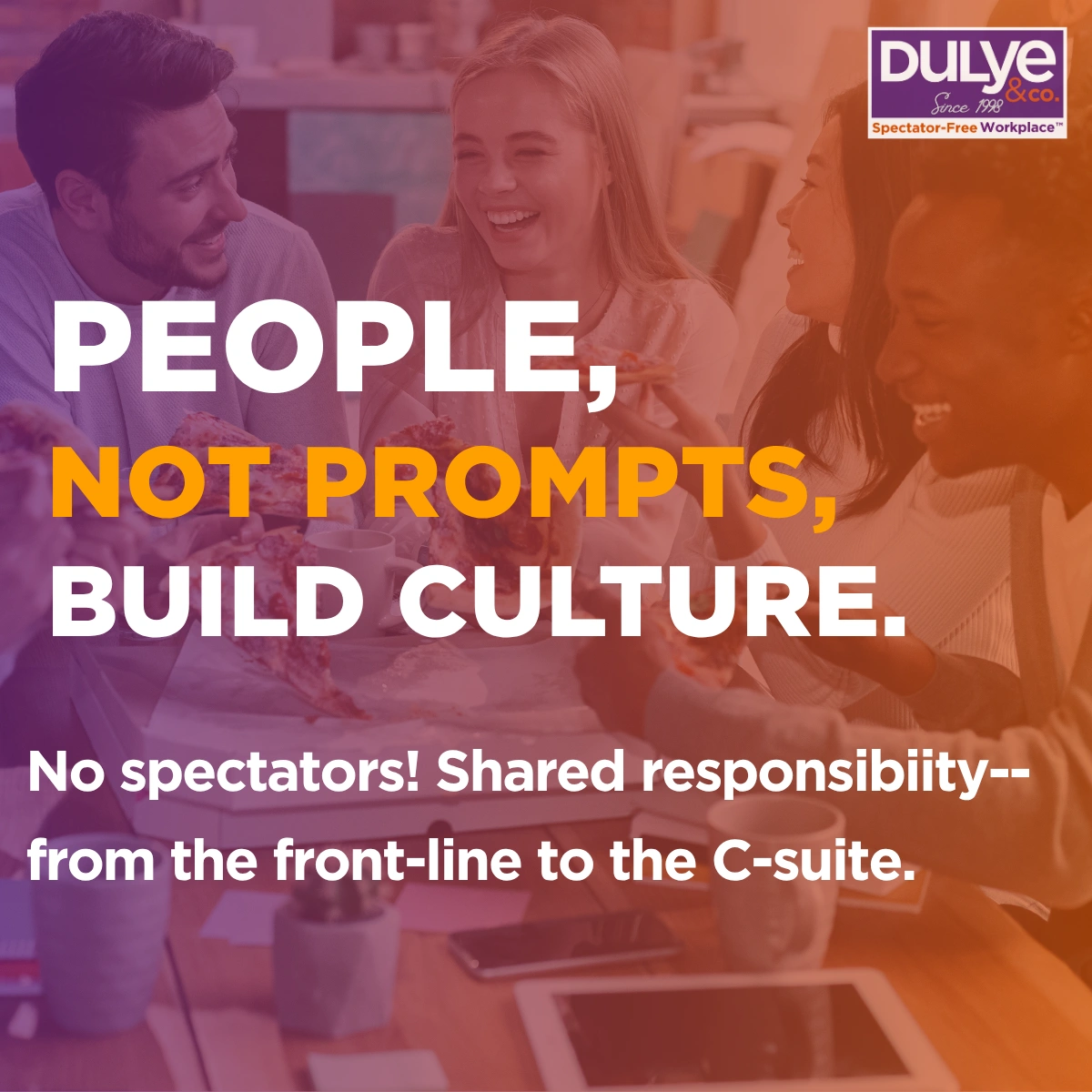
Leaders can establish the vision, but they cannot build a thriving workplace culture on their own. They must loosen their grip and invite others into the process—not as spectators, but as contributors—by:
That inclusive approach is the foundation of the Spectator-Free Workplace™ that Dulye & Co. has championed for decades.
AI may be transforming how work gets done. People, however, will always determine how well organizations perform. Culture is a shared responsibility—and one of an organization’s greatest competitive advantages.
Want to know more?